<?xml version="1.0" encoding="utf-8"?><feed xmlns="http://www.w3.org/2005/Atom" ><generator uri="https://jekyllrb.com/" version="4.3.4">Jekyll</generator><link href="https://chem-bla-ics.linkedchemistry.info/feed/by_tag/jena.xml" rel="self" type="application/atom+xml" /><link href="https://chem-bla-ics.linkedchemistry.info/" rel="alternate" type="text/html" /><updated>2026-09-26T15:06:31+00:00</updated><id>https://chem-bla-ics.linkedchemistry.info/feed/by_tag/jena.xml</id><title type="html">chem-bla-ics</title><subtitle>Chemblaics (pronounced chem-bla-ics) is the science that uses open science and computers to solve problems in chemistry, biochemistry and related fields.</subtitle><author><name>Egon Willighagen</name></author><entry><title type="html">RDF, Jena, Bioclipse, Eclipse, Zest #2: icons and an extension point</title><link href="https://chem-bla-ics.linkedchemistry.info/2010/03/04/rdf-jena-bioclipse-eclipse-zest-2-icons.html" rel="alternate" type="text/html" title="RDF, Jena, Bioclipse, Eclipse, Zest #2: icons and an extension point" /><published>2010-03-04T00:00:00+00:00</published><updated>2010-03-04T00:00:00+00:00</updated><id>https://chem-bla-ics.linkedchemistry.info/2010/03/04/rdf-jena-bioclipse-eclipse-zest-2-icons</id><content type="html" xml:base="https://chem-bla-ics.linkedchemistry.info/2010/03/04/rdf-jena-bioclipse-eclipse-zest-2-icons.html"><![CDATA[<p><a href="http://se.linkedin.com/in/jonathanalvarssson">Jonathan</a> worked this week on new features for the <a href="http://www.bioclipse.net/">Bioclipse</a>
RDF editor (see <a href="http://chem-bla-ics.blogspot.com/2010/02/rdf-jena-bioclipse-eclipse-zest-mashups.html">these</a>
<a href="https://chem-bla-ics.linkedchemistry.info/2010/02/11/bioclipse-understands-ontologies-note.html">two <i class="fa-solid fa-recycle fa-xs"></i></a> earlier items). This version still does
not edit, but only display using <a href="http://www.eclipse.org/mylyn/zest.php">Zest</a>. Jonathan created for me an extension point so
that anyone can make the editor aware of domain objects, by simply registering the extension implementation along with the
<em>rdf:Class</em> URI of the <em>rdf:type</em> of an object. This fixes the problem of having to hardcode dependencies of the RDF editor
on all the domain code, as was the case <a href="https://chem-bla-ics.linkedchemistry.info/2010/02/11/bioclipse-understands-ontologies-note.html">earlier <i class="fa-solid fa-recycle fa-xs"></i></a>.</p>

<p>For example, the cheminformatics <a href="http://wiki.bioclipse.net/index.php?title=Molecule">IMolecule</a> object is now linked to
the <code class="language-plaintext highlighter-rouge">rdf:type &lt;http://www.bioclipse.net/structuredb/#Molecule&gt;</code>:</p>

<div class="language-xml highlighter-rouge"><div class="highlight"><pre class="highlight"><code><span class="nt">&lt;extension</span> <span class="na">point=</span><span class="s">"net.bioclipse.rdf.rdf2bioobjectfactory"</span><span class="nt">&gt;</span>
  <span class="nt">&lt;Factory</span>
    <span class="na">instance=</span><span class="s">"net.bioclipse.rdf.ui.RDFToCDKMoleculeFactory"</span>
    <span class="na">uri=</span><span class="s">"http://www.bioclipse.net/structuredb/#Molecule"</span> <span class="nt">&gt;</span>
  <span class="nt">&lt;/Factory&gt;</span>
<span class="nt">&lt;/extension&gt;</span>
</code></pre></div></div>

<p>The API for this factory looks like:</p>

<div class="language-plaintext highlighter-rouge"><div class="highlight"><pre class="highlight"><code>public IBioObject rdfToBioObject( Model model, Resource res );
public ImageDescriptor getImageDescriptor();
</code></pre></div></div>

<p>This is very much tied into the Jena data model, so not entirely clean, but has to do for now. The first method converts RDF content
into a Bioclipse IBioObject, such as an IMolecule (see this <a href="http://wiki.bioclipse.net/index.php?title=Bioclipse2_core_object_model">list of currently supported objects</a>).
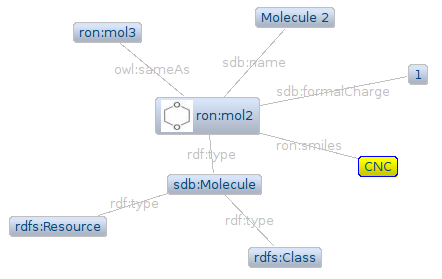
The second method returns an icon, which makes the editor more visually pleasing, and provides a nice way to see when you can double
click the RDF node to have it open in an domain specific editor:</p>

<p><img src="/assets/images/rdfEditorIcons.png" alt="" /></p>

<p>For example, double clicking the <em>ron:mol2</em> node, would open up a JChemPaint editor.</p>]]></content><author><name>Egon Willighagen</name></author><category term="rdf" /><category term="bioclipse" /><category term="jena" /><summary type="html"><![CDATA[Jonathan worked this week on new features for the Bioclipse RDF editor (see these two earlier items). This version still does not edit, but only display using Zest. Jonathan created for me an extension point so that anyone can make the editor aware of domain objects, by simply registering the extension implementation along with the rdf:Class URI of the rdf:type of an object. This fixes the problem of having to hardcode dependencies of the RDF editor on all the domain code, as was the case earlier .]]></summary><media:thumbnail xmlns:media="http://search.yahoo.com/mrss/" url="https://chem-bla-ics.linkedchemistry.info/assets/images/rdfEditorIcons.png" /><media:content medium="image" url="https://chem-bla-ics.linkedchemistry.info/assets/images/rdfEditorIcons.png" xmlns:media="http://search.yahoo.com/mrss/" /></entry></feed>